




Introduction
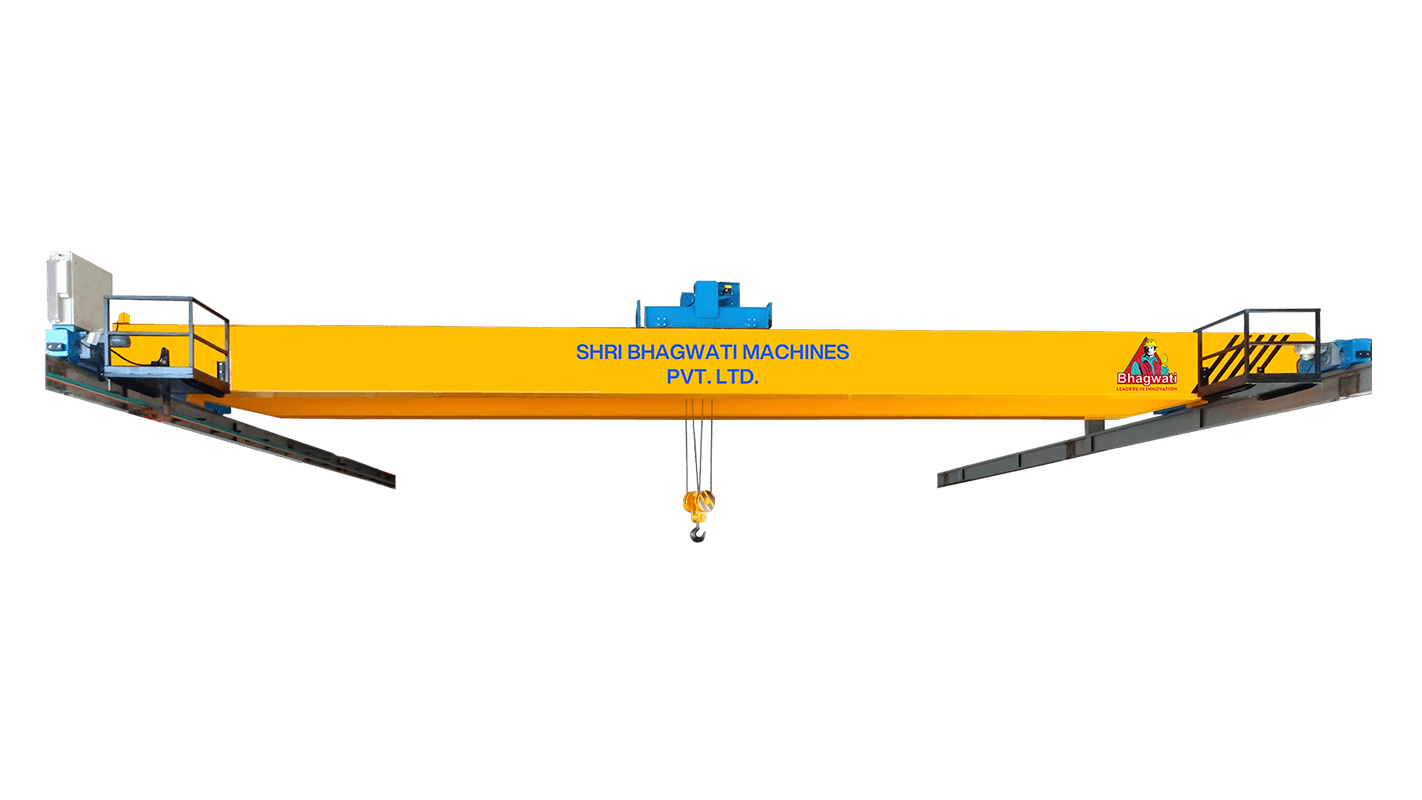
An EOT (Electric Overhead Travelling) Crane is an electrically powered overhead crane designed for lifting, lowering, and transporting heavy loads within industrial facilities. An EOT crane performs three primary movements: vertical movement of the hook for lifting and lowering, lateral movement of the trolley along the bridge, and longitudinal movement of the crane along the runway.
EOT cranes are primarily classified into single-girder and double-girder configurations. Their lifting capacities and spans vary according to the crane design, application, duty requirements, and site conditions. Single-girder cranes are generally used for light to medium-duty applications, while double-girder cranes are typically used for higher capacities and heavier-duty applications. Their overhead configuration helps optimize floor space by keeping the lifting system above the working area, allowing efficient handling of bulky and heavy loads without occupying valuable floor space at ground level.
Their overhead configuration helps optimize floor space by keeping the lifting system above the working area, allowing efficient handling of bulky and heavy loads without occupying valuable floor space at ground level.
EOT cranes are widely used in manufacturing plants, steel mills, power stations, shipyards, warehouses, workshops, and construction sites, where they facilitate the safe and efficient handling of heavy and high-volume loads.
Shri Bhagwati Machines is also among Asia’s top 10 EOT crane manufacturers. EOT cranes are commonly used in manufacturing plants, steel mills, power stations, shipyards, warehouses, and construction sites, where they handle bulky, heavy, and high-volume loads with precision and efficiency.
Overview of EOT Crane Technologies and Advanced Features
Technological innovation is transforming EOT cranes into smart, connected, and highly efficient lifting solutions capable of adapting to increasingly complex demands. Modern EOT cranes are being integrated with variable frequency drives (VFDs), PLC-based control systems, and wireless remote-control operations, allowing for smooth acceleration, deceleration, and accurate load positioning. Moreover, real-time data collection and IoT (Internet of Things)systems are being enabled to monitor operator performance, maintenance requirements, and safety compliance remotely.
1. Anti Sway Control
When an operator lifts and moves a heavy-duty load using a crane, the Anti-Sway Control system helps minimize or eliminate unwanted load swinging. By integrating this algorithm with the crane’s PLC (Programmable Logic Controller), the anti-swing system converts the operator’s commands into optimized acceleration and deceleration patterns. This improves safety, operational efficiency, positioning accuracy, and reduces mechanical wear and tear.
2. IOT (Internet of Things)
The main role of IoT is to connect the crane’s mechanical and electrical components to a digital network using sensors. This enables real-time monitoring, safety alerts, and performance analysis throughout the entire operation, from start to finish.
A Smart EOT Crane is not just a single piece of equipment; it is an integral part of a modern factory that helps make the workflow smoother, more efficient, and increasingly autonomous. Its key technological function is to provide the operator with real-time data and operational insights, enabling them to better understand the crane’s movement and momentum, make informed decisions, and perform lifting operations more easily, safely, and efficiently.
Overview of EOT Crane Applications And Installations
Applications:- EOT (Electric Overhead Traveling) cranes are widely used in industrial environments where heavy materials, machinery, components, and finished products need to be lifted, moved, and positioned safely and efficiently. By operating along overhead runways, EOT cranes can cover large working areas while keeping valuable floor space available for production and storage activities. From manufacturing plants and steel industries to warehouses, power plants, construction sites, and engineering workshops, EOT cranes support material movement at different stages of an industrial workflow.
How EOT Cranes Support Industrial Material Handling
The primary role of an EOT crane is to move heavy loads from one location to another with controlled lifting and positioning. A typical operation begins when the crane's hoist lifts the load vertically. The trolley then moves the load across the bridge, while the entire bridge travels along the runway to reach the required location.
This combination of lifting, cross travel, and long travel allows an EOT crane to position materials across a defined working area with precision. As a result, industries can reduce manual material handling, improve workflow continuity, and move heavy loads through production, storage, maintenance, and dispatch areas more efficiently.
Applications of EOT Cranes Across Industries
The application of an EOT crane depends on factors such as load weight, lifting height, operating frequency, workspace, material characteristics, and the working environment.
- Manufacturing and Engineering Industries
- Steel and Metal Industries
- Power Plants and Energy Facilities
- Warehousing and Logistics
- Automotive Manufacturing
In manufacturing plants, EOT cranes are commonly integrated into the material-handling workflow. The process may begin with lifting raw materials or heavy components from a storage area. The crane then transports these materials to the required production or assembly location. After processing, finished components can be moved to inspection, storage, or dispatch areas. EOT cranes are also used for handling heavy machinery, production equipment, fabricated structures, and large components that cannot be moved efficiently by conventional material-handling methods. This makes overhead lifting an important part of maintaining a smooth production flow.
Steel plants involve some of the most demanding material-handling operations, making EOT cranes an important part of the production process. Depending on the plant configuration, cranes can be used to handle steel billets, slabs, plates, coils, structural components, and other heavy materials. Specialized EOT cranes are also used for operations involving ladles and molten metal. The workflow can extend from steel melting and processing to movement of semi-finished products and finally the handling of finished steel products for storage or dispatch. For heavy-duty applications, crane configuration, lifting capacity, duty class, and specialized attachments must be selected according to the operating conditions.
Power plants require the movement of large and high-value equipment during installation, maintenance, and replacement activities. EOT cranes can assist in handling components such as turbines, generators, transformers, stators, rotors, and other heavy equipment. During maintenance, the crane can lift a component from its operating position, transport it to a designated maintenance area, and reposition it after servicing. This controlled movement is particularly valuable where heavy equipment must be handled accurately within restricted working areas.
In large warehouses and industrial storage facilities, EOT cranes can support the movement of heavy goods between receiving, storage, handling, and dispatch areas. A typical workflow starts with unloading incoming material. The crane can then lift and position the load in its designated storage area. When the material is required, it can be retrieved and moved toward the loading or dispatch zone. This helps organizations manage heavy materials without relying entirely on manual handling and can make better use of available working space.
Automotive manufacturing involves the movement of heavy machinery, vehicle components, engines, dies, and other production equipment. EOT cranes can support different stages of the manufacturing workflow by transferring components between production areas, assembly stations, maintenance zones, and storage locations. In larger automotive facilities, reliable overhead material movement can help maintain production continuity while reducing the need to move heavy components manually.
Installations
The installation of an EOT crane begins with preparing the building structure and creating a suitable runway along the area where the crane will operate. Before the crane is assembled, the runway beams, rails, supporting columns, electrical supply, and required clearances are checked to ensure that the structure can safely support the crane and its operating loads. Once the foundation and supporting structure are ready, the main crane components, including the bridge girders, end carriages, trolley, hoist, and electrical systems, are brought to the installation area. The bridge girders are then positioned on the runway rails and connected with the end carriages to form the main travelling structure.
Next, the trolley and hoisting mechanism are installed on the bridge, allowing the lifting unit to travel across the crane span while the complete bridge can travel along the length of the building. The electrical panels, festoon or conductor systems, control cables, limit switches, brakes, sensors, and other safety components are then connected and integrated with the crane control system. After mechanical and electrical assembly is completed, the crane is carefully aligned and inspected to verify that the bridge, trolley, wheels, hoist, and lifting mechanism operate correctly. The crane then undergoes no-load and load testing to check lifting, lowering, travelling, braking, emergency stops, limit switches, and overall operational performance. Only after these checks confirm that the crane operates safely and according to its specified capacity is it handed over for regular industrial operation. In this way, EOT crane installation is a complete process that connects the building structure, mechanical components, electrical systems, control technology, and safety mechanisms into one coordinated overhead lifting system.
FAQ's
- Q. What are the key safety features to look for in industrial overhead cranes?
- Q. How to choose the right EOT crane for manufacturing plants?
- Q. How to perform daily inspection of an overhead traveling crane?
- Q. Cost of a 10-ton double girder EOT crane with installation.
In EOT Crane have many safety features that directly protect the working and operating system like Safe Load Indicators, Anti-Collision, Limit Switches, Automatic Braking Systems, Audible Alarms, Sway Control. So, each buyer before buying EOT Crane should look at these features.
First, to choose the right EOT crane, you need to determine the required lifting capacity or load for your manufacturing plant, such as 10, 20, 50, or 100 tons. After determining the required capacity, you should learn about the available technology upgrades for EOT cranes, such as anti-sway control, IoT (Internet of Things), and other advanced features. Based on all these requirements, you can select the right EOT crane for your manufacturing plant.
For the daily inspection of an EOT crane, you should check its lifting capacity by handling heavy products in the plant under the supervision of a safe and experienced operator. This provides a real and practical inspection of the EOT crane.
The cost of a 10-ton double-girder EOT crane typically ranges from ₹5,00,000 to ₹30,00,000, while the installation cost generally ranges from ₹70,000 to ₹1,50,000. The final cost may vary depending on the crane specifications, technology, and installation requirements.
Conclusion
An EOT crane does not just lift heavy loads — it keeps an entire industrial operation moving. From receiving raw materials at the unloading point to positioning finished products for final dispatch, it works overhead, silently connecting every stage of production without disrupting the factory floor below. With lifting capacities that can exceed 100 tonnes and spans that can extend beyond 30 metres, EOT cranes can be equipped with advanced features such as Anti-Sway Control, VFD-based motion control, PLC systems, and IoT-enabled monitoring for enhanced precision, safety, and reliable heavy-duty performance. Installation is a complete process — from preparing the runway structure and assembling bridge girders to integrating electrical systems, testing under load, and verifying every safety mechanism before handover. The result is not just a machine, but a fully coordinated overhead lifting system ready for industrial operation. For industries that deal with heavy materials, high volumes, and the need for accurate load positioning, an EOT crane is not optional equipment. It is the system that holds the entire production process together — from the first lift to the last.